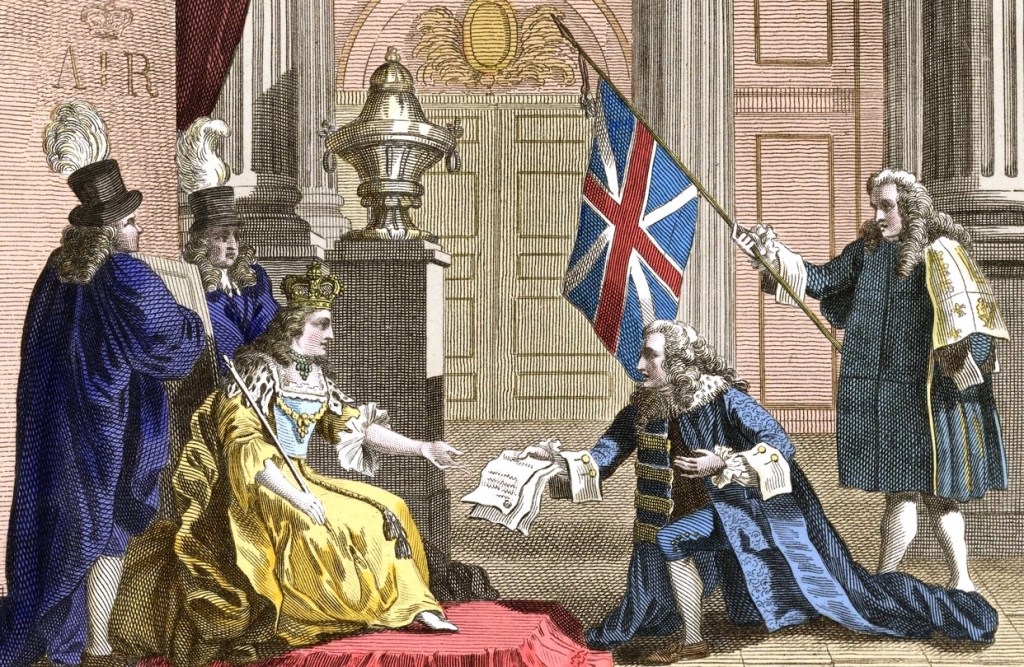
The union of 1707 remains arguably the most contentious event in Scottish history. The Kingdom of
Scotland was born 843AD, making her 864 years old by the time of “ane end o’ ane auld sang” (Earl of Seafield, 1707). “Scottish national identity at the time drew on a mythical history, forged in the medieval wars of independence, portraying Scotland as an admirably ancient and unconquerable kingdom. It was widely believed that brave martial Scots had maintained the freedom of the kingdom for over 2000 years.” (Scottish History Society,2023). So, the question stands; what
motivated Scotland to give up her statehood after a millennium?
There are two unions that led to the third in 1707. The marriage of the Thistle and Rose, 1503 saw James IV of Scotland marry Princess Margaret Tudor of England, not only intertwining the houses of
Stuart and Tudor but also the future of Scotland and England. 100 years later in 1603 the marriage would see its biggest consequence; the grandson of James and Margaret, King James VI of Scots
inherited the throne of England after Queen Elizabeth I died with no heirs. Without 1503, 1603 could not have happened and without 1603, 1707 could not have happened. The 17th century for Scotland was a century of decline and anglicisation. 1603, James VI moved to London from Edinburgh to rule over his Kingdoms, with him went Scotland’s poets and playwrights. He described the move ‘as trading a stony couch for a deep feather bed.’ (Nosowitz, 2020). Foreshadowing how Scotland would be viewed and treated from now on.
1651 The Navigation Acts were passed by the English Parliament; the affects were detrimental to the Scottish economy. Scotland was banned from trading with English colonies and constantly
harrased by England’s navy. The effects of the Union of Crowns and Navigation acts to Scotland can be examined through a quote from a parliamentary speech by Andrew Fletcher of Saltoun “Our
trade was formally and so flourishingly a condition that the shire of fife alone had as many ships as now belong to the whole kingdom.” [Fletcher, 1703]. Scotland’s economic situation led the country
to pass an act on the Darien Scheme in 1695 to establish a trading colony in Panama. By 1700 this venture failed due to a multitude of reasons ranging from disease, Spanish attacks, and refusal of
help from the King due to the East India Company. The failure of the scheme saw a lot of wealthy Scots a little less wealthy, a lot of those men sat in the Scottish Parliament. This was a key motive in
Scotland accepting the union, to regain the trade that had been lost since the Union of Crowns and failed to come to fruition in Darien. The Darien scheme was also a motivation of England for seeking
union. At the time England’s East India Company was one of the most powerful in the world and had a monopoly over much of the world’s trade, Scotland setting up the Company of Scotland and
setting out on colony adventures could harm the companies’ monopolies and revenue, in turn harming tax revenues to the English Government. A Scotland under the same parliament couldn’t
get in the way.
Moving into the 18th century ‘The Act of Settlement 1701’ (England) was passed, if Queen Anne died with no heirs the throne would pass to the House of Hanover, Scotland was not consulted on this. Scotland held elections in 1702 and the government that was returned did not seem intent on union. They set out passing laws to reassert Scotland’s position as a free and independent people. The Act of Security 1703, Scotland would choose its own successor to Queen Anne if she passed with no heirs, ending the union of crowns unless England allowed free trade with her and her colonies. Act anent Peace and War 1703 was passed taking the power to declare war and peace away from the monarch and giving it to the Scottish Parliament, ending Scotland and England’s shared foreign policy. Finally, the Wool Act 1703 and Wine Act 1703 were passed declaring Scotland would trade with European nations whether England was at war with them or not. This is when England hit back with what I believe was one of Scotland’s motives for accepting union; the Alien Act 1705. The act declared if Scotland did not accept the Hanoverian Succession and enter union talks all Scottish exports into England would be banned, all lands owned by Scots in England would be seized and according to Daniel Defoe twenty-four war ships were fitted out to stop Scotland trading with France. [Defoe, p.86&54.] This would have devasted an already weak Scottish economy. The passing of the Alien Act seems to me one of England’s motives for union, Scotland was becoming tired of
what Andrew Fletcher described as “all our (Scotland) affairs since the Union of the Crowns have been managed on the advice of English ministers. By which means they have had so visible an influence upon our whole administration that we have appeared from that time to the rest of the world more like a conquered province than a free and independent people!” [Fletcher, 1703] England could see Scotland was becoming restless and seeking to assert herself especially after Darien, to which England viewed as a threat to her foreign interests, So, sought to keep Scotland under heel.
In December 1704 James Johnstone wrote from London to Baillie of Jerviswood that “the spirit here runs upon conquest or union.” [Bannantyne, p.42]. Suggesting if Scotland did not want union, there
wouldn’t be much choice. This was reaffirmed in 1706 when on the 26th November Sir David Nairne wrote from London to the Earl of Mar that “The troops on the boarders are three regiments of foot,
and in the North of Ireland three of horse, one of foot and one of dragoons, and they have the necessary orders.”[Nairn, 1706] I believe this was another key motive for Scotland accepting the
union, fear of fighting a bloody war they couldn’t win.
It’s clear Scotland’s motive for accepting union was not the will of the people. After the draft treaty was made public a mob wandered Edinburgh threatening parliamentarians, Glasgow, Dumfries and
Lanark had taken to arms burning the treaty. Stirling sent anti-union petitions to the parliament. Pro union commissioner Sir John Clerk of Penicuik expressed at the time “Sad examples appeared everyday of how widely parliament and people had diverged, for not even one percent approved what the former was doing.” [Clerk,1707].
Debt and taxes were one of England’s motives for seeking union. The equivalent of £398,085 was paid to Scotland in return for Scotland accepting union and taking on a share of England’s debt
forever. In return this lessened England’s high taxes to pay its war debts and the Scottish taxpayers got a tax rise. However, I believe this was also one of the motives for members of the Scottish
Parliament accepting the union. It is widely speculated part of the equivalent was paid to individuals that voted yes. An investigation by George Lockhart in 1711 discovered that £20,540.17 was paid to
members of the Scottish Parliament who happened to vote yes. For example, the Duke of Roxburgh was paid £500. [Lockhart,1711].
The union in its first twenty years was very unstable. In 1708 the Scottish Privy Council was abolished and replaced with the Secretary of State for Scotland. 1712 the House of Lords become the Court of Appeal for Scottish cases, leading to many cases of misjudgement as Scots law was new to the English. These events led to the attempted ending of the union by the new Scots MPs, however this was voted down by the large English majority. Unrest remained within the Scottish population, in 1714, crowds in Perth cried “No Union.” Dundee a year later declared “Dissolve and put an end to that unhappy union” (YouTube 2018). Until it all finally turned into a full-blown
uprising for as what Captain John Nairn, 1715 described as “a rising to assist in dissolving the union and making Scotland a free nation.” [Nairn,1715] However the uprising was defeated by government
forces. It is important to note the 1715 rising had a multitude of motives within its ranks; religion, independence, politics. The fact the Scottish Establishment and population both tried to end the
union shows it did not bear the fruits some had hoped for up until that point.
In conclusion, I believe that the main motives of the English Government in seeking union were that England since 1603 had become accustomed to swaying Scottish affairs and drawing upon the
monarch’s power over Scotland to favour England. England was a highly taxed, war like nation that had global interests, however it needed more taxes and men to draw upon to further itself, Scotland
having been reduced to a shadow of itself but still a potential base of taxes and men was extremely attractive. After Darien and the Act of Security, the English government saw no other option but to
neutralise Scotland one way or another to protect England’s interests. Regarding Scotland, her motives were of self-preservation, that seems contrary to what happened as her independence was
given up. However, Scotland was presented with two choices. One was a future of economic warfare with England and a potential invasion by her much superior military, what would Scotland have become had she lost such a war? An annexed region like had happened to Wales? Every time Scotland had tried to reverse her fortunes since 1603 something stopped it, whether it be miscalculations, her King, her neighbours, or mother nature herself. This is why the Scottish Government chose the future where Scotland got to keep her law system, religion, and educational institutions. However, it must be noted the Scottish Government were not selfless in this decision due to some of the equivalent that happened to land in the pockets of those who voted for the union.
By James Leslie. (Sources below donation form)
Make a one-time donation
Make a monthly donation
Make a yearly donation
Choose an amount
Or enter a custom amount
Your contribution is appreciated.
Your contribution is appreciated.
Your contribution is appreciated.
DonateDonate monthlyDonate yearlySources;
- The society (no date) The Scottish History Society. Available at: https://scottishhistorysociety.com/popular-opposition-to-the-ratification-of-the-treaty-of-anglo-scottish-union-in-1706-7/#:~:text=Many%20people%20came%20to%20Edinburgh%20to%20follow%20the,their%20magistrates%20refused%20to%20address%20against%20the%20union. (Accessed: 24 October 2023).
- Nosowitz, D. (2020) How the English failed to stamp out the Scots language, Atlas Obscura. Available at: https://www.atlasobscura.com/articles/scots-language (Accessed: 27 October 2023).
- Scotland’s Story-The 1707 Union With England (2018). YouTube. 27 March. Available at: https://www.youtube.com/watch?v=X9uav5Je9Kg (Accessed: 27 October 2023).
- Westminster passes the Alien Act 1705 – UK Parliament (no date) Westminster passes the Alien Act 1705. Available at: https://www.parliament.uk/about/living-heritage/evolutionofparliament/legislativescrutiny/act-of-union-1707/overview/westminster-passes-the-alien-act-1705/
- Correspondence of George Baillie of Jerviswood (Bannantyne Club, 1842), p.42
- Defoe, The History of the Union Between England and Scotland (London, 1786), pp. 86 and 54
- Union of Parliaments (no date) National Library of Scotland. Available at: https://www.nls.uk/collections/rare-books/collections/union-of-parliaments/ (Accessed: 29 October 2023).
- Will Scotland lose her identity? (no date) Union of 1707 – Opinions against Union. Available at: https://www.scottisharchivesforschools.org/union1707/chapter5.asp (Accessed: 29 October 2023).
- (2018). YouTube. 14 May. Available at: https://www.youtube.com/watch?v=0_zXZz0Jar8 (Accessed: 01 November 2023).
- Report of the Manuscripts of the Earl of Mar and Kellie (Historical Manuscripts Commission, London, 1904) p.336


 The Scotland Post
Leave a comment