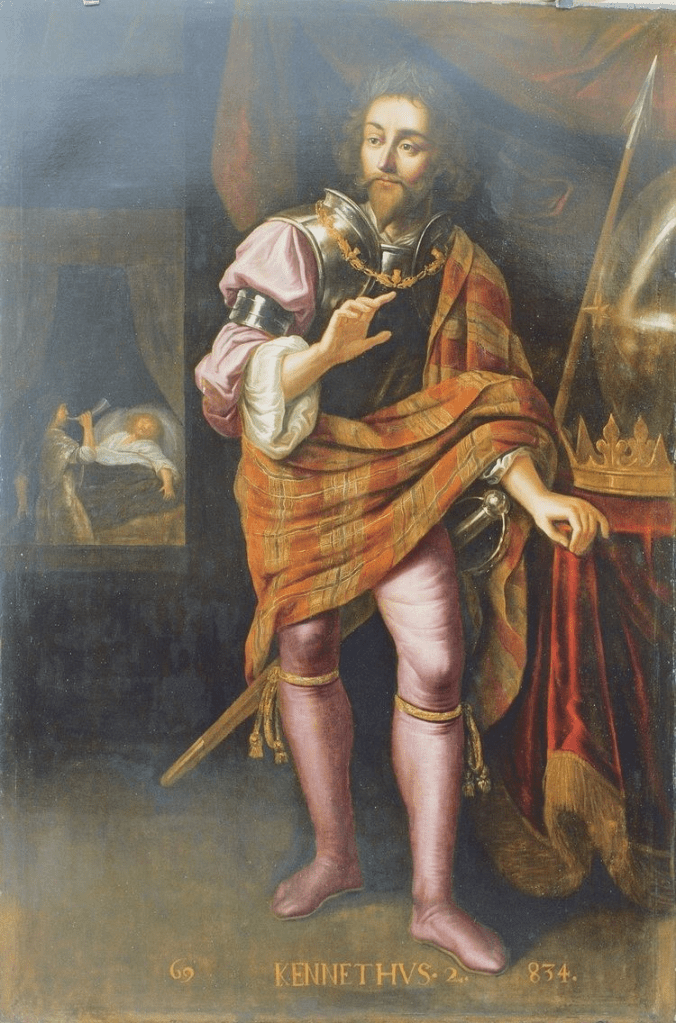
To most Scottish people, it feels as though our history begins with William Wallace and Robert the Bruce. This is done intentionally so that Scots view ourselves through a British lens—as a rebellious footnote to a larger story. But the real story of Scotland begins much, much earlier, in the blood and smoke of the 9th century. Kenneth I didn’t just inherit a kingdom; he engineered one out of the chaos of the Viking age.
The World of the 9th Century: A Land of Four Nations
What we know as Scotland today was ruled by four Kingdoms in the 9th century.
The Picts: Occupying the North and East, they were the “indigenous” power, famous for their intricate stone carvings and fierce resistance to Rome.
The Gaels (Scots): Based in Dál Riada (Argyll), these were Kenneth’s people, originally from Ireland, bringing with them the Gaelic language and the Christian traditions of Iona.
The Britons: Centered at Alt Clut (Dumbarton Rock), they ruled the Kingdom of Strathclyde in the Southwest.
The Angles: The Germanic settlers of Northumbria who controlled the Southeast (the Lothians) up to the Firth of Forth.
Kenneth I can be traced back as the ancestor of the modern British monarchy today. Kenneth was the son of Alpín mac Echdach, a prince of the Cenél nGabráin—the royal house of Dál Riada.
His father, Alpín, was a warrior who met a grisly end. History suggests Alpín was a claimant to the Pictish throne who was defeated and beheaded by the Pictish King Óengus II after a battle in Galloway around 834 AD. Legend says his head was placed on a spike for all to see at the Pictish capital. “Alpin died in Galloway, after he had destroyed it and devastated it. And then the Scots were conquered by the Picts.” > — The Chronicle of the Kings of Alba. Kenneth didn’t just inherit a throne; he inherited a blood feud and a kingdom on the brink of collapse. He grew up in a culture of “Vengeance and Valor,” where a son’s primary duty was to restore the honor of his father’s house.
The Mystery of the Missing Years: 834 or 841?
A glaring question often overlooked by historians is the “gap” in Kenneth’s timeline. If Alpín died in 834 AD, why did it take Kenneth until 841 AD to become King of the Scots?
In the 9th century, a seven-year delay usually meant a brutal, internal power struggle. Under the Gaelic system of Tanistry, the throne didn’t automatically go to the eldest son; it went to the strongest male relative. Kenneth likely spent those “missing years” in a shadow war against his own kin—uncles and cousins—proving through blood and steel that he was the most capable warlord to lead.
However, modern research suggests Alpín may actually have lived until 840 or 841 AD. If this is true, it paints Kenneth as a lightning-fast opportunist. It means he seized the crown of Dál Riada just as a catastrophic event in the East changed the fate of the north forever. So the question remains did Kenneth’s father die in 834 or 841?
The Apocalypse of 839 AD
In 839 AD, the Viking Army struck the heart of Pictland with a ferocity that shook the foundations of the British Isles. The Pictish military was not just defeated; it was annihilated.
“The heathens won a battle against the men of Fortriu, and in it fell Eogán son of Óengus, Bran son of Óengus, Aed son of Boanta, and others almost innumerable.” > — The Annals of Ulster.
For the Picts, this was a total decapitation of their society. With their King, his brother, and the “innumerable” nobility dead on the field, the East of Scotland was effectively a leaderless wasteland. To Kenneth MacAlpin, this was a moment of supreme opportunity. He possessed a maternal claim to the Pictish throne, and he moved to claim it. While this move provided the stabilization needed to prevent a total Viking takeover, it was not viewed as a “rescue” by everyone.
To the surviving Pictish families, Kenneth was a Gaelic intruder. He did not come to restore the Pictish line; he came to replace it. A rare glimpse into the Pictish sentiment is found in the Prophecy of Berchán, a historical poem that reflects on the character of the kings:
“A son of the clan of his father shall take [the kingdom]… a man of the many-dishes, the fierce one… he was the first of the men of Gabrán to possess [the land] in the east, after the bitterness of the Picts.” > — The Prophecy of Berchán
The phrase “after the bitterness of the Picts” is telling. It suggests that the Pictish transition into Kenneth’s kingdom was not a joyful union, but a period of resentment and loss. Kenneth was the “fierce one” who took the East by force. He utilized a Viking tragedy to launch a Gaelic coup. The Picts didn’t choose to become Scots; they were forced into a new identity because their own had been shattered by the Vikings and then swallowed by Kenneth.
The Triumph at Scone: Establishing the Sacred Center
Every nation needs a heart, and Kenneth found it at Scone. His greatest military victory was the five-year campaign (843–848 AD) to pacify the northern territories. By seizing Scone, he didn’t just win a strategic hill; he established a Coronation Tradition that would last for a millennium.
By bringing the Stone of Destiny to Scone, Kenneth told the world that the King of Alba was not just a warlord, but a divinely sanctioned ruler. He understood that to unite the Scots and Picts, he needed a symbol that was greater than any one tribe. Scone became the birthplace of the Scottish state—a place where the blood of the West and the land of the East became one.
The Architecture of Alba: Engineering a New Identity
Kenneth’s genius wasn’t just on the battlefield; it was in his ability to build a shared culture. He knew that a kingdom held together only by fear would crumble. To create a permanent state, he used the three pillars of civilization:
1. The Spiritual Union Kenneth moved the relics of St. Columba to Dunkeld. This was a masterstroke of religious diplomacy. By placing the Gaels’ most holy saint in the heart of Pictland, he created a unified church. Scots and Picts now knelt before the same relics. He didn’t erase Pictish faith; he gave it a new, powerful focus that bound them to his throne.
2. The Law of MacAlpin He replaced the confusing, often conflicting local customs with a standardized legal code. The “Laws of MacAlpin” provided a “Fair Play” system that allowed Scots and Picts to trade, marry, and settle disputes under one king. He was the first ruler to treat the north as a single legal entity.
3. The Diplomatic Shield Kenneth was a master of the “long game.” Despite his nickname “The Conqueror,” he knew when to use a wedding ring instead of a sword. After the Britons of Strathclyde burned Dunblane in 849 AD—his most significant defeat—he didn’t spiral into a cycle of revenge. Instead, he married his daughter to their King. He turned a border conflict into a family alliance, securing the peace for the next generation.
The Six Invasions: Defining the Border
Kenneth was the first king to define where “Scotland” ended. He invaded Northumbria six times, burning the outposts at Dunbar and Melrose. These weren’t raids for plunder; they were boundary markers. He was telling the English Saxons that the land north of the Tweed belonged to the House of Alpin. Every time he crossed the border, he was etching the map of modern Scotland into the earth.
Military Triumphs and Borderline Defeats
Kenneth’s legitimacy as An Ferbasach was maintained through a policy of “Aggressive Defense.” He recognized that a new kingdom is most vulnerable at its borders, and he spent much of his reign ensuring his neighbors stayed on the defensive. He is recorded as having invaded the Saxon kingdom of Northumbria six times. These were not merely raids for cattle or gold; they were strategic strikes against the fortresses of Dunbar and Melrose. By burning these southern outposts, he established a clear message: the new Kingdom of Alba was an expansionist power that would not be contained.
However, he was not invincible. Around 849 AD, his southern flank collapsed when the Britons of Strathclyde launched a devastating retaliatory strike, burning Dunblane to the ground. This was a massive blow to his prestige, proving that his new kingdom was still fragile. This defeat forced Kenneth to pivot from pure military aggression to the “Blood and Silk” of diplomacy. He eventually married his daughter, Rhun, to the King of the Britons, effectively buying a peace he could not win on the battlefield. This marriage was a pivotal moment in Scottish history, as it began the slow process of drawing the southern Britons into the orbit of the House of Alpin.
Legacy and Memory: The Invention of Scotland
Kenneth MacAlpin died in 858 AD, likely of a tumor—a surprisingly quiet end for a man whose life was defined by the clatter of the shield-wall. He was buried on the Isle of Iona, the traditional resting place of kings, but the nation he left behind was something entirely new.
As Richard Oram points out, the “House of Alpin” that we talk about today is, in many ways, a later historical construction. Medieval chroniclers needed a “First King” to justify Scottish independence during the 13th-century invasions by England. They took the figure of Kenneth—a ruthless, opportunistic Gaelic warlord—and polished him into a visionary founder of a nation. They turned his hostile takeover into a “Union” and his erasure of the Picts into a “Merging.”
Yet, the physical legacy of his reign remains. He brought the Stone of Destiny to Scone, establishing a coronation ritual that would define the Scottish monarchy for a thousand years. He moved the capital of the north from the isolated west to the powerful east, ensuring that the future of Scotland would be centered in the fertile Lowlands. He did not just create a kingdom; he created a bloodline. For three centuries, every man who sat on the throne of Scotland had to prove he was a “Son of Kenneth.”
Where to Experience Kenneth’s World Today
If you want to understand the scale of Kenneth’s ambition, you must visit the places where he literally shifted the foundations of the north:
- The Moot Hill at Scone: This is where Kenneth established his power base. It is the site where the Pictish kingdom died and the Scottish kingdom was born. Standing there, you can still feel the weight of the centuries.
- Dunkeld Cathedral: Though the current building is later, this remains the site where Kenneth brought the relics of St. Columba. It represents the moment he unified the church to support his crown.
- The Isle of Iona: Kenneth’s final resting place in the Reilig Odhráin. He returned to the ancestral home of his people in death, having ensured their language and culture would dominate the north forever.
Next Week: Donald I – The Lawgiver or the Tyrant? When Kenneth died, the throne did not go to his son, but to his brother, Donald. Was he the man who saved the union, or a drunken leader who almost lost it all? We will dive into his “pagan” controversies and the mysterious laws that nearly tore the new kingdom apart.
Sources & Further Reading:
- Oram, Richard. The Kings and Queens of Scotland. (Stroud: Tempus, 2001).
- Woolf, Alex. From Pictland to Alba: 789–1070. (Edinburgh University Press, 2007).
- Broun, Dauvit. Scottish Independence and the Idea of Britain. (Oxford University Press, 2007).
- YouTube: Every Scottish Monarch from Kenneth I to James VI
Make a one-time donation
Make a monthly donation
Make a yearly donation
Choose an amount
Or enter a custom amount
Your contribution is appreciated.
Your contribution is appreciated.
Your contribution is appreciated.
DonateDonate monthlyDonate yearly
 The Scotland Post
Leave a comment