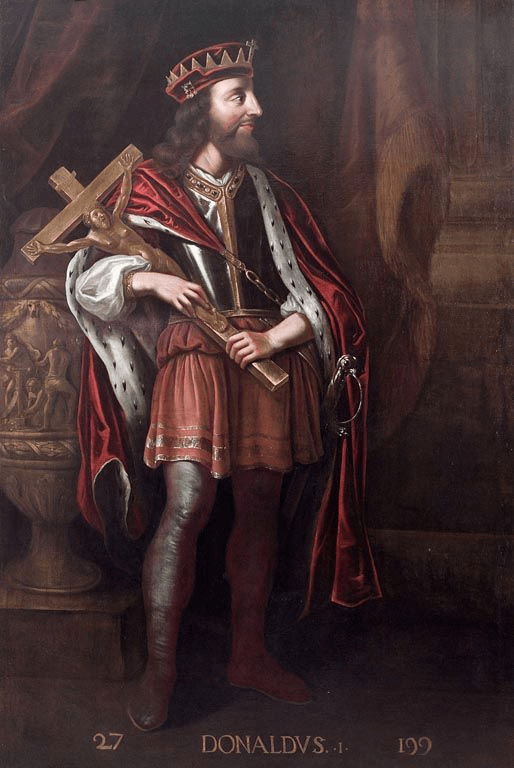
Like Kenneth I, there is little records on his brother Donald I. Pre 1100 almost everything was transmitted orally and very little was written down. When Edward I of England’s armies came north in the late 1200’s and invaded Scotland they siezed and destoryed much of Scotland’s early archives, so much of what would have been known about early Scottish monarchs are lost to history.
What we do know about Donald I largely comes from sources written centuries later.
The Inheritance of Smoke: Scotland in 858 AD
When Kenneth MacAlpin died in February 858, the Kingdom of Alba was less a nation and more a fragile military occupation. To understand the political instability Donald inherited, we must look at the Annals of Ulster, which record the year of his accession as a time of relentless Viking pressure and internal shifting.
“Cinaed son of Ailpín, king of the Picts, and Adalstéin, king of the Saxons, died.” -(Cinaed being Kenneth MacAlpin the I)
While the entry seems brief, it signaled a geopolitical earthquake. The death of two major kings in Britain in a single year left a power vacuum that the Vikings were eager to fill. Scotland was in a state of unrest; the “Union” of the Scots and Picts was less than twenty years old, and the indigenous Pictish population remained a “submerged” power, waiting for the Alpinid dynasty to falter.
Donald did not take the throne because he was Kenneth’s son; he took it because he was the Tanist (the elected successor). In a world of Viking longships, a kingdom could not afford a child-king. As Richard Oram explains in his chapter on the Alpinids, the succession of a brother over a son was a calculated move to ensure royal dynasty. At the time of Donald’s reign, wealth was measured in cattle and the ability of a King to protect his people’s grain stores. Society was “Peripatetic.” The King did not sit in a stone capital; he moved with his court, literally eating the taxes as he went.
The Mystery of the Bloodline: The “Foreign” Mother-
What we do know about Donald is that the ‘Prophecy of Berchán’ (which isn’t much of a prophecy as it was written in the 12th century, Donald reigned in the 9th). is that it described him as “The wanton son of the foreign wife… he will be three years in the kingdom; his tombstone will be above Loch Awe.”
The ‘prophecy’ has led historians to debate over two theories. The first being that Alpin, Donald and Kenneth’s father took a second foriegn wife which in 9th century Britain almost always meant Norse who then gave birth to Donald suggesting he was the product of a strategic alliance with the Vikings, no sources regard Kenneth’s mother as foriegn which gives fuel to this theory. The second theory suggests that the tales of Kenneth and Donald’s mother being a Pictish princess is a myth to justify the merger of the Scots and Picts and to give legtimacy to their claims over the Pictish throne.
What do you think is the more likely theory?
The Legal Takeover-
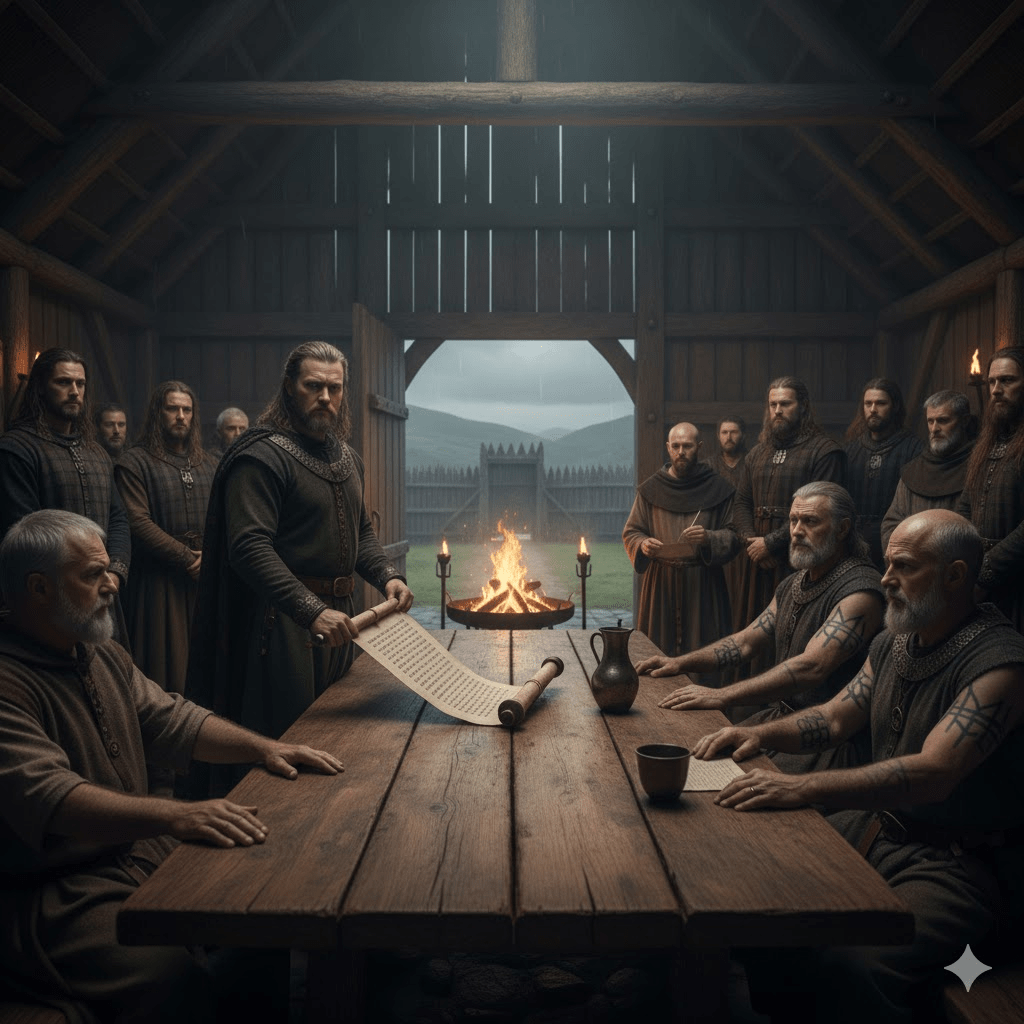
Donald I’s most significant act took place at the Council of Forteviot in 858 AD.
The Chronicle of the Kings of Alba provides the defining quote of his reign:
“In his time the Gaels established the rights and laws of the kingdom of Áed, the son of Eochaid, with their king in Forteviot.”
The Significance of the Law: Áed Find (Áed the White) was a King of Dál Riada (the Scots) from the previous century. By imposing his laws on the Pictish, Donald was cementing Scottish rule over the Kingdom.
- Inheritance Reform: He replaced Pictish matrilineal custom with Gaelic patrilineal succession. This allowed Gaelic lords to marry Pictish noblewomen and legally claim their lands for their sons, bypassing the Pictish brothers.
- Land Tenure: He established that all land was ultimately held by the King, forcing Pictish lords to pay “food-renders” (taxes) directly to the House of Alpin.
- Spiritual Alignment: He aligned the Pictish Church with the Gaelic traditions of Iona and Dunkeld, effectively erasing Pictish religious autonomy.
Viking Cold War-
While the Annals of Ulster are filled with accounts of Viking massacres in Ireland—such as the entry for 860 AD describing the burning of noble dwellings—Donald’s Scotland remained strangely quiet.
The “Cold Peace”?: Donald likely maintained a “Strategic Neutrality.” He recognized that the Vikings in Dublin (under Olaf the White) wanted silver and slaves. By keeping internal trade routes open and focusing on domestic legal suppression, Donald made Alba a “hard target.” As Oram notes, Donald bought the time the dynasty needed to solidify.
Rising Power or Decline? For the Picts, this was a terminal decline of their culture. For the Scots, it was a rising power. The economy was shifting toward a “proto-state” where the King’s law, not tribal custom, dictated the flow of wealth.
The ‘Vigorous Soldier’: The Chronicle of Melrose describes Donald as a “vigorous soldier in war.” This implies that the “peace” recorded in the Annals was actually a result of suppression.
- Fortification: Donald occupied and refortified Iron Age hillforts like Dundurn.
- The Gall-Gael Mercenaries: The Annals of Ulster mention the Gall-Gael (Foreign Gaels). Donald likely used these mixed-race warriors as a “police force” to keep the Pictish heartlands under control.
The Vengeance of the Stones-

Scottish folklore and legend believe that symbol stones can remember and become witnesses with memories of kingship and oaths which could reveal truth when touched by a rightous person. This belief is rooted in Pictish and later Gaelic tradition. The legend of ‘The Wise Woman’ claims Donald I ordered his church at Forteviot to be built on buried Pictish symbol stones and sacred ground. While the foundations were being layed a Pictish wise woman appeared who is described as ‘a guardian of the old laws’. She warned the King that the land was sacred and the stones remembered the old gods and kings, silencing them would bring a price. Donald ignored her and refused to stop the works. In response she cursed him:
“That no son of his body would sit the throne after him, that his line would end in silence, and that the stones would remember what men chose to forget.”
In some versions she vanishes into the earth, in others she is driven away and in some darker tellings she is killed on the Kings orderes, sealing her curse on Donald in blood.
While there is no historigraphical evidence this actually happended what it does do is represent the end of the Picts during Donalds reign, the word ‘Pict’ disappears and the Kingdoms name of ‘Alba’ is now fully cemented. Pictish culture did not end during his reign but it does mark the end of Pictish as a recognised political and cultural category, althought it’s people and traditions remained. It is also important to note Donald did die with no heirs and his line did in fact end.
Conclusion: The Legacy of the Scribe
Donald I died in 862 AD. The Annals of Ulster (AU 862.1) record:
“Domnall son of Ailpín, king of the Picts, died.”
He is important because from the sources it appears he kept the nation stable and together.
A Question for the Reader:
“History usually remembers the guys who win the big battles, like Kenneth MacAlpin. But Donald I shows us that sometimes, the person who writes the laws and keeps the peace is just as important. If you were a Pictish lord back then, would you have accepted Donald’s ‘new’ laws for the sake of peace, or would you have risked a rebellion to keep your old traditions alive?”
Sources & Further Reading:
- Oram, Richard. The Kings and Queens of Scotland.
- Woolf, Alex. From Pictland to Alba: 789–1070.
- Annals of Ulster (AU 858-862).
- Hudson, Benjamin. Prophecy of Berchán.
- YouTube: The Kings of Alba | British History
Next Week: Constantine I (Causantín mac Cináeda)
The “Cold Peace” of Donald I ends here. Next week as we will look at the son of Kenneth MacAlpin, Constantine I, a king forced to rule through the fire of the Great Viking Army. We will explore the Siege of Dumbarton, the brutal realities of the Viking occupation of Fife, and how Constantine attempted to save a young Scotland from total Viking annexation.
Make a one-time donation
Make a monthly donation
Make a yearly donation
Choose an amount
Or enter a custom amount
Your contribution is appreciated.
Your contribution is appreciated.
Your contribution is appreciated.
DonateDonate monthlyDonate yearly
 The Scotland Post
Leave a comment