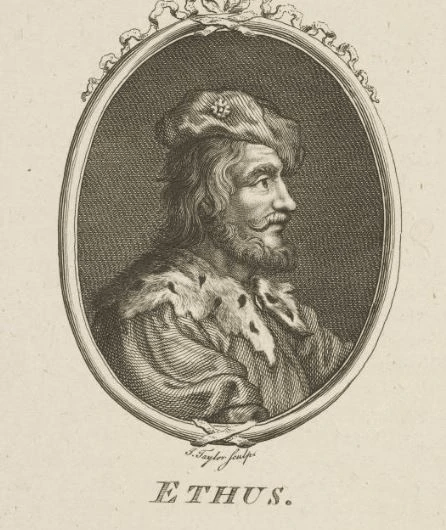
I. Scotland at the Start: A Kingdom of Ghosts
When Áed took the throne in 877 AD, he wasn’t inheriting a kingdom; he was inheriting a graveyard. His brother Constantine had been killed by Vikings, and the economy was “scoured” by a decade of war. Political stability was non-existent. The “unrest” mentioned in the Annals suggests that the Pictish nobility saw Constantine’s death as an opportunity to reclaim their old lands.
As Alex Woolf notes in From Pictland to Alba, Áed came to power in a “power vacuum.” The Vikings had temporarily withdrawn, but they had left behind a country with no money, no crops, and a very angry aristocracy.
II. The Legend of the “White Flowers” vs. The Fact of the “Fleet-Footed”
History gives Áed two very different faces.
- The Myth: The Prophecy of Berchán calls him “Áed of the White Flowers.” In Gaelic tradition, flowers are often symbols of youth or a “doomed” beauty. The legend suggests Áed was a king who loved the land more than the sword.
- The Fact: The Chronicle of the Kings of Alba uses the Latin alipes (Fleet-footed). The legend claims he could outrun any horse in the Highlands. In the 9th century, being “swift” was a vital military trait—it meant you could strike and vanish before the Viking longships hit the shore.
III. Main Event: The Rise of the Usurper (Giric)
The most significant “Main Event” of Áed’s one-year reign was the emergence of Giric mac Dúngail. Relationships and Court Life: Giric is a shadowy figure. Some legends say he was Áed’s foster-brother; others say he was a Pictish lord who hated the Alpinid “Scots” takeover. The court life under Áed was a nest of vipers. While Áed was trying to rebuild the defenses, Giric was in the shadows, whispering to the disgruntled Mormaers. This was the first true Alpinid Civil War.
IV. Relations with Foreign Powers: The Silent Vikings
Curiously, there are few records of Viking battles during Áed’s year.
- The Theory: The Vikings in Dublin were busy with their own internal feuds.
- The Reality: The “foreign power” Constantine had so brutally suppressed was waiting. By leaving Áed alone, the Vikings allowed the Scottish nobility to turn on itself. It was the ultimate “divide and conquer” strategy without the Vikings having to lift a single axe.
V. The Core Section: The Battle of Nrithim and the End
The reign ended not in a Viking raid, but on a battlefield in Strathallan.
- The Fact: The Annals of Ulster (AU 878.2) are direct: “Áed son of Cinaed, king of the Picts, was killed by his own associates.”
- The Legend: The story goes that Áed was lured into a pass at Nrithim under the guise of a parley. His “swift feet” couldn’t save him when his own guards—his lucht-tighe—turned their spears around.
This murder broke the “Law of the King” that Donald I had worked so hard to establish. If a king could be killed by his own people, the Alpinid experiment was over.
VI. The Curse Revisited: The Wise Woman’s Satisfaction
Remember the Wise Woman’s Curse from our Donald I post? In the taverns and villages of 878 AD, the people wouldn’t have blamed “politics” for Áed’s death—they would have blamed the spirits. The legend says that as Áed fell, the “White Flowers” of the hillside turned red, signaling that the Alpinid line was being punished for destroying the Pictish symbol stones.
A Question for the Reader:
“Áed was known as ‘The Swift-Footed,’ but he couldn’t outrun a knife in the dark. In a world where your own ‘associates’ are your biggest threat, is it better to be a king who is loved for his ‘white flowers’ or a king who is feared for his iron fist?”
Next Week: Giric the Great and the Eclipse of Alba
With Áed dead, the Alpinid line is broken. Join us next week as we meet the most controversial man in Scottish history: Giric. Was he a savior who freed the Scottish Church from the Picts, or a ruthless killer who stole a throne that wasn’t his? We’ll be looking at the Eclipse of 885 AD and the strange decade where the “Sons of Alpin” disappeared from history.
Make a one-time donation
Make a monthly donation
Make a yearly donation
Choose an amount
Or enter a custom amount
Your contribution is appreciated.
Your contribution is appreciated.
Your contribution is appreciated.
DonateDonate monthlyDonate yearly
 The Scotland Post
Leave a comment